There is a line of argument in education reform discourse that makes me crazy. It can be summed up by these two sentences from Washington Post’s coverage of what they called a Rhee/Ravitch debate last August.

The “debate” was actually a six person panel discussion. You can watch it in full at the WEB Du Bois Institute’s website.
“Ravitch argued that poverty causes achievement gaps and that the best solution is to offer poor children extra support and resources from birth on.
Rhee agreed that poverty plays a role but said educators must focus on what they can control.”
As described, these are nonsense positions. They seem to be answering a nonsense question: Which should we address, poverty or educational quality? I would like to meet the person who sneakily framed this as an either/or question and watched as kids floundered through years of stagnant debate over which of their basic needs adults should meet.
Why should Ravitch’s support for systemic anti-poverty measures preclude an effort to improve US curriculum and instruction? Ravitch doesn’t believe it does. She is an educational historian who cares about curriculum and teacher training and lesson implementation. I’M SURE OF IT.
Rhee’s position is a defense against the complacency of educators who say they can’t fix poverty, so they shouldn’t be held accountable for their students’ educational outcomes.
Those teachers are wrong. If I had to be their boss, I would be sorely tempted to shout them down.
But it’s easy to spot a teacher who is using external circumstance as an excuse for his own incompetence or bigotry. There are other teachers who talk about the million and one ways that economic hardship impacts their kids. They are witnesses to suffering, they want to be heard, and they want something done. It is not smart to shout them down.
After family, teachers spend the most time with kids and are uniquely positioned to serve as their advocates. I think teachers have more within their control than Rhee thinks they do.
I want to take an expansive view of what a classroom can be, and I don’t want to be defined by zero sum equations. Let’s assume that if something impacts kids’ learning, we’re going to take a shot at it. So, first things first: you must have the body.
Ways to Have a Healthier Year
Experts

How the world looks in my imagination.
Last year, there was a public health fair at our middle school. When I heard that this fair was coming, for some reason I pictured a glitzy event with dozens of booths and lots of swag. Please don’t ask me why. It’s a little embarrassing to admit. When I did march my class down to the auditorium to find five card tables decorated with a few cardboard tri-fold boards set up on the stage, I felt a little deflated.
My students did not. They solemnly cycled through EVERY TABLE. They asked questions and drew pictures and made health pledges. They treated their public health visitors like royal ambassadors. Other classes piled up in line behind ours to experience the fair. Total success.
So what I’m saying is, if you work in public health, can you please come visit my school? You don’t have to do anything fancy. Just bring the knowledge and training that I don’t have, and some tips for follow-up.
Food
Sometimes the other teachers in my team will exclaim as they set up for our morning meeting, “Did you see what so-and-so was eating for breakfast today? Soda and red hot cheetos. How do our kids make it through the day?!”
You never hear me making observations like that, because I simply cannot judge. I fail at feeding myself. I’ve been able to survive off mostly fast food and bodega fare for a few years now. The man I buy my diet coke from at 7 am every morning knows my name, occupation, and my testing and vacation schedule, and I know how long he’s been in the country and how his daughter’s regents load and college application process are going. That’s a lot of diet coke. I do not approach nutrition from a position of mastery.
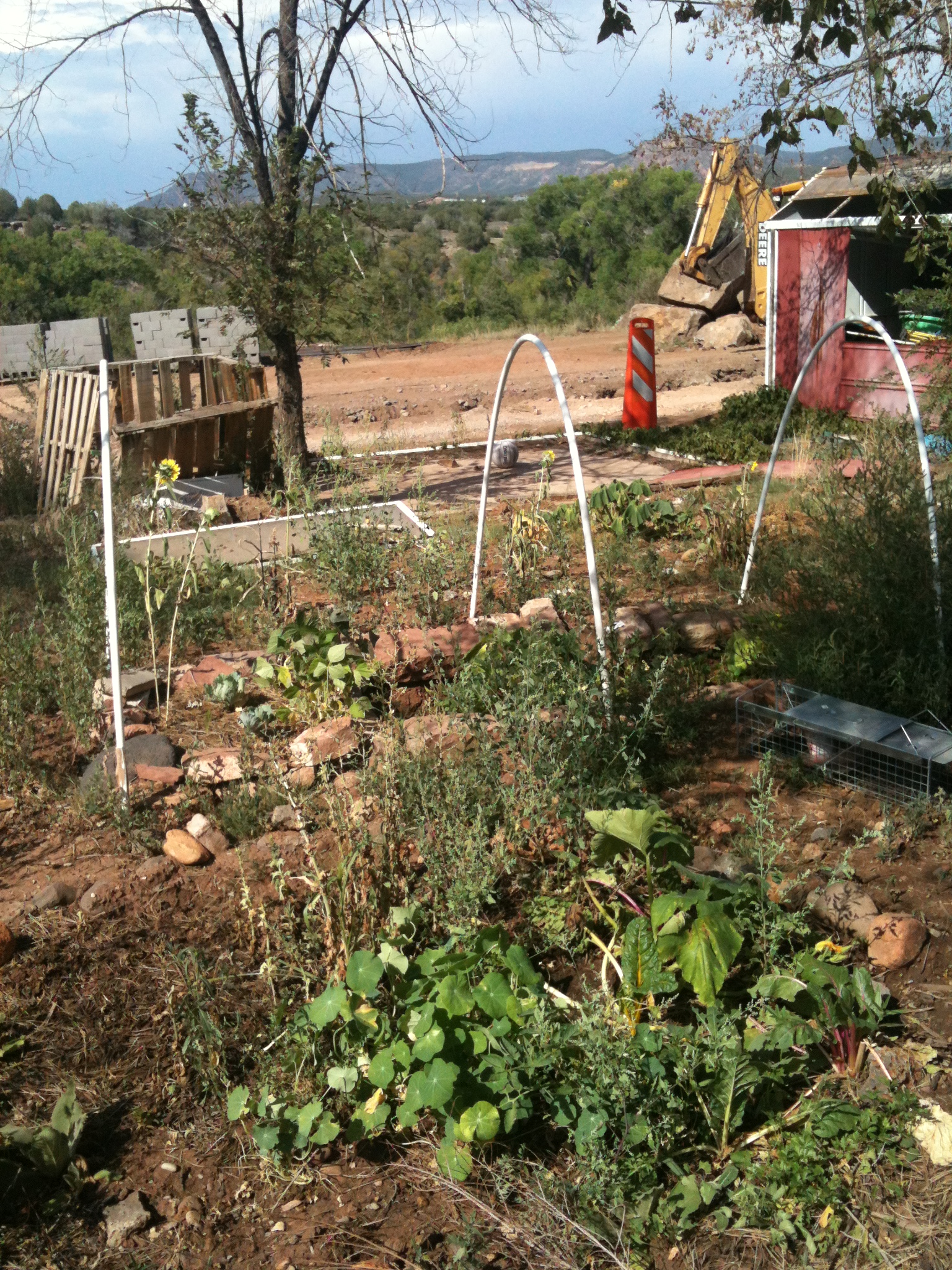
We lived off this chard for a week.
However, I’ve been thinking about food a lot this summer. A few weeks ago I spent a week with Rebecca Wilkinson, whose new roommate in Ft. Apache is a volunteer with Food Corps. Did you know there was a Food Corps? I did not, and I suspect the people who would oppose a new federally-supported program in which volunteers teach kids how to raise food don’t know about it either. Anyway, Becca’s new house is impressive, and full of all kinds of real food. There are vegetables planted in every corner of the yard, tucked into garden beds but also old tires and coolers. The kitchen is stocked with dozens of jars of grains and dry beans that I would not know what to do with (hyperbole, I know you soak the beans overnight, please do not write me to tell me so or report me to my mother).
The most fun I had taking care of the garden was when the kids from the neighborhood came over to help. One girl, Joanie, was fascinated with all of it. She helped me make stuffed zucchini for dinner (pick everything in the garden that is ripe, sauté it with ALL the herbs, and stuff a zucchini with it) and she thought it tasted so amazing that she made me write down the recipe (“recipe”). Then we walked around the garden again harvesting ingredients for her to take home. Just like my students at the health fair, it didn’t take much to capture Joanie’s imagination.

Curb-grown artichokes
Assuming there are no Food Corps members reading this who want to come to my school and make a garden on our roof—what feasible goal can I set to bring a little of Joanie’s excitement into my classroom? Alix suggests I try One Small Plant. A tomato plant, maybe. Something that my students can watch grow, and eat from. In Portland this week, where people grow gardens in the space in front of their houses between the sidewalk and the curb, I took pictures of all the vegetables I could. Maybe I can use that as decoration around our One Small Plant.
There’s knowledge of where food comes from, but there’s also simple necessity, so I need to be stocked with snacks. I’ll probably start out with a supply of granola bars in September, but if you have ideas of other nourishing, filling, non-perishable foods I can have on hand, please let me know.
Healthcare
My school is lucky. Our building is part of Montefiore’s School Health Program, the largest school-based health network in the country. It means we have an actual doctor’s office in our building. My principal is meticulous about getting every one of our students registered at the center, having up-to-date medical records, and scheduling physicals for kids if their information is out of date.
I have not taken proper advantage of this level of access. In fact, the only advantage I’ve taken is charming my way into the program’s roving flu vaccination van after it had already closed up shop one night last November. I know my kids love the FNP who works downstairs, because they embrace her whenever they see her, but she and I have hardly talked, and I can do better.
My goal this year is to actually visit on the school center on my own, without students, and have a conversation with someone about the services that are available there. I especially want to talk about ways I can support my students in managing their chronic asthma.
THREE GOALS:
1) Reach out to NY public health youth programs, and bring one visitor into my classroom
2) Grow One Little Plant
3) Get to know my school-based health center
GOALS ACHIEVED:
None yet

 ms.staab.com
My friend here in Ithaca has a job working for the Food Bank of the Southern Tier, traveling around to local schools and teaching about hunger and poverty. I’m sure there are similar programs in NYC.
http://www.foodbankst.org/index.asp?pageId=78
Posted by Hel | August 29, 2012, 11:27 amOooh, yes. This looks like it. Kids can get trained to be peer nutrition educators, I love it!
Edited to Add: Ok, I just emailed their teen program coordinator, let’s see what happens! Maybe we can get some of our kids trained as nutrition educators as one of our monthly community service projects. Then they can teach me!
Posted by msstaab | August 29, 2012, 6:18 pmHahaha, their teen program coordinator is my friend Megan, I’m pretty sure. She’s Quaker!
Posted by Hel | August 29, 2012, 7:02 pmTo whom it may concern (Yes I am Hel Staab’s sister!!): Greetings.
Posted by msstaab | August 29, 2012, 8:08 pmLook at the website for “Earth Boxes”. They are amazing inventions that enable a lot of plants to be grown in a very small space. See if they will donate one to your school. They have a whole watering and feeding system that maximizes plant growth.
Anna, I am Tara’s mom. I would be happy to share recipes with the students – cheap, easy to cook, and healthful (read some beans lol!!)
Posted by Martha | August 29, 2012, 3:16 pmAmazing, thanks Martha! I’m sure I can get a DonorsChoose project for an EarthBox–maybe one of the junior ones you can fit in a window. And I’d love to have your recipes! Maybe my class could have something like a quarterly after-school potluck, with parents invited. I wish there was a way to cook at school–Albert Leonard had a whole fleet of stoves in Home Ec, the way I remember–but I’m sure we could figure out a way to make it work.
Posted by msstaab | August 29, 2012, 6:14 pmAnna, check out the Herring Gut Learning Center, Port Clyde, ME: they have an aquaponics set up that ME teachers are setting up in their classrooms. You can grow veggies on the waste water from goldfish~teaching some science – ecology cycles etc. etc. – by observations in the classroom and then eat the veggies. Along with Earth Boxes that would be so cool. At Herring Gut they grow tilapia – bigger than goldfish – and then cycle the water into the greenhouse to grow lettuce that they then sell to high end restaurants. They do teacher training in the summer so come along. I bet your kids would love it. Kids from Harlem’s Children’s Zone have come up to visit the ocean for the first time in their lives. by the way, I absolutely agree with your comments in reference to the Ravitch/Rhee debate. I find such things a diversion, but not very helpful to teachers who have a group of children/young adults who need so much more than academic discussions. We certainly do know that the stresses of poverty increase cortisol levels to a point that children will not be able to meet the challenges of classrooms. How do we help parents reduce their own stresses so they have something left over to help their children reduce theirs? a big question that no one seemingly wants to touch. linda
Posted by Linda h. Small | August 29, 2012, 7:39 pmI would love to come to Herring Gut. Do they have summer workshops for teachers?
And yes, the stresses are incredible. When I think about what school was like for me when I was going through a complicated grieving process, to be honest I think about mountain climbers on Everest. They can be the strongest climbers in the world, and at that height the simple act of walking is Herculean–that’s how I felt, like I was typing research papers with two hands behind my back. I FELT LIKE I WAS TYPING WITH MY FACE.
So many of my students have losses in their family and kinship network on the regular, and that is just one facet of their families’ stress. I guess some people just don’t understand that? No, not everyone can just do ABC. They are climbing up higher than you.
Posted by msstaab | August 29, 2012, 8:16 pm